
What Is the IPO Process?
The IPO Process (Initial Public Offering Process) is the structured procedure through which a private company offers its shares to the public for the first time and becomes a publicly listed company on a stock exchange.
In simple terms:
The IPO process is how a company transitions from private ownership to public ownership by issuing shares to investors.
This process involves regulatory approval, valuation, documentation, investor marketing, subscription, allotment, and final listing on a stock exchange.
Why Do Companies Go Through the IPO Process?
Before understanding the steps, it’s important to know why companies choose to go public.
1. Raise Capital for Expansion
Companies use IPO funds to:
- Expand operations
- Invest in new technology
- Reduce debt
- Acquire competitors
- Enter new markets
2. Improve Brand Visibility
A publicly listed company gains:
- Higher credibility
- Media attention
- Investor trust
- Stronger market positioning
3. Provide Exit to Early Investors
Promoters, venture capitalists, and angel investors can partially or fully exit their investment.
4. Increase Company Valuation
Public listing helps establish transparent market-based valuation.
IPO Process: Step-by-Step Explanation
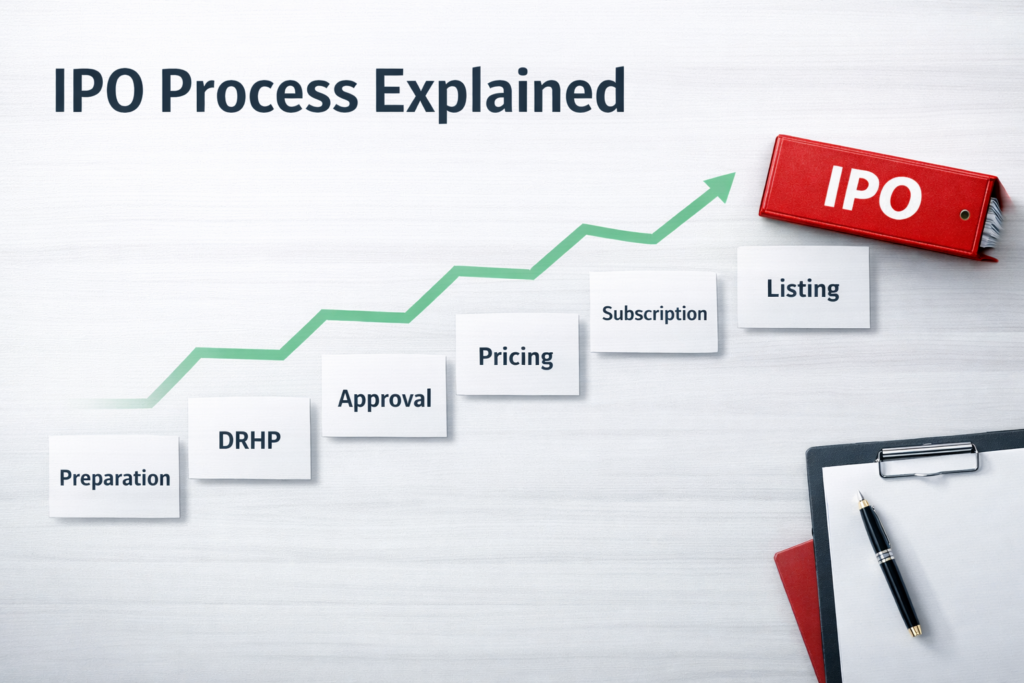
Below is the complete IPO process explained in structured stages.
Step 1: Internal Preparation and Decision Making
The IPO journey starts when:
- The Board of Directors approves the decision.
- Financial health is reviewed.
- Corporate governance systems are strengthened.
- Compliance gaps are identified and corrected.
At this stage, companies also evaluate:
- Market timing
- Industry trends
- Profitability track record
- Growth projections
Preparation may take 6–12 months before filing.
Step 2: Appointment of Intermediaries
To manage the IPO process, the company appoints:
- Investment bankers (Lead Managers)
- Legal advisors
- Auditors
- Registrars
- Underwriters
- Compliance experts
Role of Investment Bankers
They:
- Structure the IPO
- Decide issue size
- Help in valuation
- Prepare offer documents
- Coordinate with regulators
- Market the IPO
Their experience significantly impacts IPO success.
Step 3: Due Diligence and Draft Red Herring Prospectus (DRHP)
This is one of the most critical stages.
What is Due Diligence?
It is a complete financial, legal, and operational verification of the company.
This ensures:
- Transparency
- Accuracy in disclosures
- No hidden liabilities
After due diligence, the company files:
Draft Red Herring Prospectus (DRHP)
The DRHP includes:
- Business overview
- Financial statements (3–5 years)
- Risk factors
- Promoter details
- Industry analysis
- Use of IPO proceeds
- Litigation details
- Management discussion
In India, this is filed with SEBI for review.
Step 4: Regulatory Review and Approval
The regulatory authority reviews the DRHP carefully.
They check:
- Accuracy of financials
- Risk disclosures
- Legal compliance
- Investor protection measures
If required, changes are suggested before final approval.
Once approved, the company proceeds to launch the IPO.
Step 5: IPO Pricing Method
Pricing is one of the most strategic decisions in the IPO process.
There are two major methods:
1. Fixed Price IPO
- The company sets a fixed price.
- Investors apply at that price.
2. Book Building IPO (Most Common Today)
- A price band is announced (e.g., ₹100–₹120).
- Investors bid within that range.
- The final issue price is decided based on demand.
Book building allows better price discovery and reflects real market demand.
Types of IPOs
Understanding IPO types helps investors analyze opportunities better.
1. Mainboard IPO
Large companies list on major stock exchanges.
2. SME IPO
Small and Medium Enterprises raise funds through SME platforms.
SME IPO process is similar but has:
- Lower compliance threshold
- Smaller issue size
- Focused investor base
SME IPOs are increasingly popular in India.
Step 6: Roadshow and Investor Marketing
Before opening the issue to the public, the company conducts a roadshow.
This includes:
- Presentations to institutional investors
- Meetings with fund managers
- Financial performance explanation
- Growth outlook discussions
Purpose:
- Build demand
- Gauge investor sentiment
- Strengthen subscription levels
Strong roadshows often result in oversubscription.
Step 7: IPO Subscription Period
The IPO opens for public subscription for 3–5 days.
Investors apply under categories:
- Retail Investors (RII)
- Qualified Institutional Buyers (QIB)
- Non-Institutional Investors (NII / HNI)
If demand exceeds available shares, the IPO becomes oversubscribed.
Oversubscription generally indicates strong investor interest.
Step 8: Allotment of Shares
After subscription closes:
- Applications are verified.
- Shares are allotted based on category quota.
- Retail investors may receive shares via lottery in case of oversubscription.
Funds are debited only after allotment confirmation.
Step 9: Listing on Stock Exchange
This is the final stage of the IPO process.
Shares are listed on stock exchanges such as:
- National Stock Exchange (NSE)
- Bombay Stock Exchange (BSE)
On listing day:
- Shares start trading.
- Market determines the actual price.
- Listing gain or loss occurs.
Listing performance depends on:
- Market sentiment
- Subscription level
- Valuation
- Economic conditions
What Happens After IPO Listing?
The IPO process does not end at listing.
1. Continuous Disclosure
Public companies must:
- Publish quarterly financial results
- Disclose major corporate actions
- Maintain governance standards
2. Lock-In Period
Promoters may be restricted from selling shares for a specific period.
3. Market Monitoring
Share price fluctuates daily based on performance and market trends.
Advantages of the IPO Process
For Companies
- Large capital infusion
- Increased valuation
- Brand credibility
- Easier future fundraising
- Liquidity for shareholders
For Investors
- Early investment opportunity
- Potential listing gains
- Long-term wealth creation
- Portfolio diversification
Risks and Challenges in the IPO Process
1. High Costs
Legal, underwriting, compliance, and marketing costs are substantial.
2. Regulatory Pressure
Public companies face strict reporting requirements.
3. Market Volatility
Poor market conditions can impact listing performance.
4. Ownership Dilution
Promoters lose partial control due to share dilution.
Key Factors That Determine IPO Success
- Strong revenue growth
- Consistent profitability
- Low debt levels
- Clear expansion strategy
- Reasonable valuation
- Positive industry outlook
- Experienced management team
Investors should analyze these before investing.
IPO Process in India: Key Regulatory Framework
In India, IPOs are regulated by:
- Securities and Exchange Board of India (SEBI)
- Stock exchanges (NSE & BSE)
- Registrar and Transfer Agents
Important compliance aspects include:
- Minimum public shareholding norms
- Disclosure standards
- Corporate governance requirements
- ASBA process for application
Understanding these improves investor awareness and reduces risk
FAQ:
-
What is the IPO process?
The IPO process is the structured procedure through which a private company offers its shares to the public for the first time and becomes a publicly listed company. It includes preparation, appointment of merchant bankers, due diligence, filing of the Draft Red Herring Prospectus (DRHP), regulatory approvals, pricing, public subscription, share allotment, and final listing on stock exchanges regulated by the Securities and Exchange Board of India (SEBI).
-
How long does the IPO process take in India?
In India, the IPO process typically takes 6 to 12 months. The timeline depends on company readiness, financial documentation, regulatory approvals, and market conditions. Companies with strong compliance records and organized financials may complete the process faster.
-
What are the eligibility criteria for launching an IPO in India?
To launch an IPO in India, a company must meet SEBI eligibility norms, which generally include:
Minimum track record of financial performance
Adequate net tangible assets and net worth
Proper corporate governance standards
Conversion into a public limited company before filingEligibility requirements may vary depending on whether it is a Mainboard or SME IPO.
-
What is a Draft Red Herring Prospectus (DRHP)?
The Draft Red Herring Prospectus (DRHP) is a detailed legal document submitted to SEBI during the IPO process. It includes financial statements, business model, risk factors, promoter information, industry overview, and proposed use of IPO funds. The DRHP helps regulators review the company and allows investors to make informed decisions.
-
What is the difference between a Mainboard IPO and an SME IPO?
A Mainboard IPO is designed for larger companies with stricter financial and compliance requirements and is listed on platforms like the National Stock Exchange (NSE) or the Bombay Stock Exchange (BSE).
An SME IPO is meant for small and medium-sized enterprises with relatively lower eligibility requirements and smaller issue sizes. SME IPOs are listed on dedicated SME platforms of these stock exchanges.